A hydroponic herb garden grows fresh culinary herbs in water and nutrients year-round — no soil, no outdoor space, no seasonal limits. Hydroponics herbs like basil, mint, and cilantro grow faster than they would in dirt, right from your kitchen counter, ready to harvest in as little as 21 days.
I went through published growing data from university extensions, community forums, and manufacturer specs to build the herb-by-herb reference table I couldn't find anywhere else. I'm a content curator, not a licensed agronomist — everything here is backed by linked sources so you can verify anything that matters to your setup. All prices in this guide are estimates based on current market data and are subject to change — always check current listings before buying.
This guide covers which 8 herbs work best, their specific growing parameters, how to harvest for continuous production, and the real grocery savings math. If you're new to hydroponics entirely, start with our indoor hydroponic garden guide for the full system overview — then come back here for herb-specific data.
Why herbs are the best crop for a hydroponic garden
Herbs are the best hydroponic crop for home growers because they're fast, cheap to grow, and save more money per square foot than anything else you can put in a system.
They're ready in 21–30 days, need only moderate light (not the high-output LEDs that fruiting plants demand), and fit in a single jar. Short-season non-fruiting plants are the best choices for indoor hydroponic production, according to the University of Minnesota Extension — and herbs fit that description better than anything else on the list.
Here's how herbs compare to the other popular hydroponic crops:
Herbs vs leafy greens vs fruiting crops — compared across the metrics that matter most to home hydroponic growers.
Herbs win on every metric that matters to a home grower: speed, space, simplicity, and dollar-for-dollar grocery savings. A $3 package of fresh basil lasts a week. A single basil plant in a Deep Water Culture (DWC) tote or Kratky jar lasts months.
The 8 best hydroponics herbs (with real growing data)
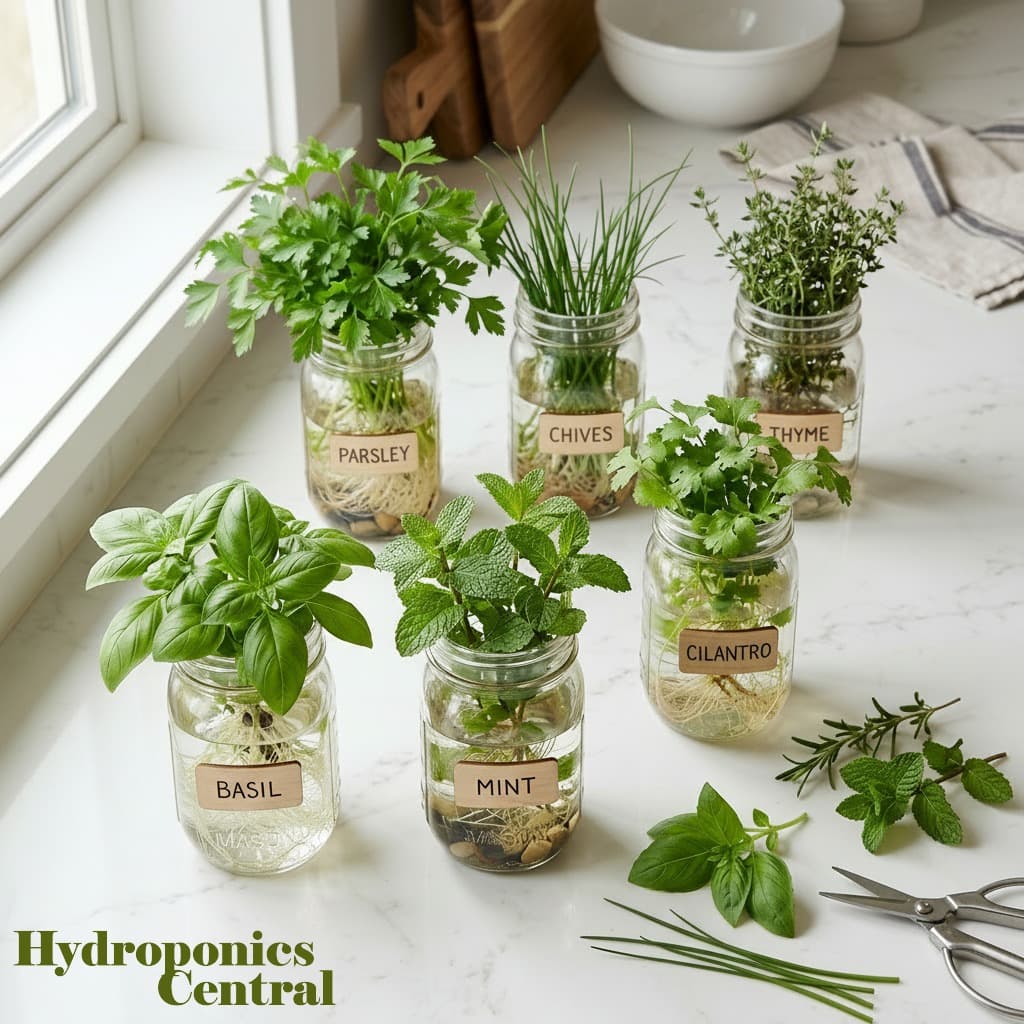
Basil, mint, parsley, and chives are the best herbs to grow hydroponically for beginners — all ready in 21–45 days, tolerant of a wide pH range, and productive for months with regular harvesting.
Penn State's PlantVillage confirms basil, chives, cilantro, thyme, and parsley as reliably successful hydroponic herbs, noting they thrive specifically because they don't need to go through the stressful flowering and fruiting stage that makes tomatoes and peppers so demanding.
Most guides stop there, without the numbers you actually need to manage your system. I pulled growing parameter data from published hydroponic references, extension resources, and community-reviewed growing guides to build a single reference table.
Growing parameters for 8 hydroponic herbs — pH range, EC range, light requirements, temperature, and days to first harvest.
The EC and pH ranges above are drawn from published hydroponic reference data for herbs and corroborated by community growing documentation. Use them as your starting point and adjust based on how your specific plants respond.
Basil
Basil is the fastest and most productive hydroponic herb, reaching first harvest in 21–28 days and producing continuously for 3–6 months with regular pruning. Genovese and sweet varieties grow abundantly and respond well to harvesting. Keep pH between 5.5 and 6.5 and provide strong light — basil stretches and becomes leggy without enough.
Mint
Mint grows faster and more aggressively than any other herb in a hydroponic system — productive and nearly indestructible, but always needs its own container. Spearmint and peppermint both work well. Its aggressive root growth will overtake a shared reservoir and choke out neighboring plants within weeks.
Cilantro
Cilantro is the trickiest hydroponic herb because it bolts quickly in temperatures above 70°F, cutting the productive leaf cycle short. It's worth growing, but plan for short cycles — see the harvest section below for the staggered-planting workaround.
Parsley
Parsley takes 30–45 days to first harvest but produces reliably for months once established — flat-leaf (Italian) varieties have the strongest flavor and fastest regrowth. It's slower to germinate than basil but requires minimal attention once it's established.
Chives
Chives take 30–40 days to establish but then produce continuously — snipping the leaves triggers new growth from the base, making them one of the lowest-effort herbs to maintain long-term.
Thyme
Thyme prefers lower humidity and tolerates slight underfeeding compared to basil or mint — it grows slowly but lasts longer than most hydroponic herbs once established. It pairs especially well with a Kratky jar where the water level naturally drops, giving roots the periodic drying thyme prefers.
Oregano
Oregano grows similarly to thyme at 35–45 days to harvest, but needs slightly warmer conditions — Greek oregano has stronger flavor and more compact growth than common varieties, making it the better choice for a dedicated hydroponic setup.
Rosemary
Rosemary is the hardest common herb to grow hydroponically, taking 60–90 days to first harvest and needing careful pH management and lower moisture levels than most systems naturally provide. A Kratky jar with diluted nutrient solution works better than active systems, since rosemary and other woody herbs prefer periodic drying between waterings.
Which system is best for herbs?
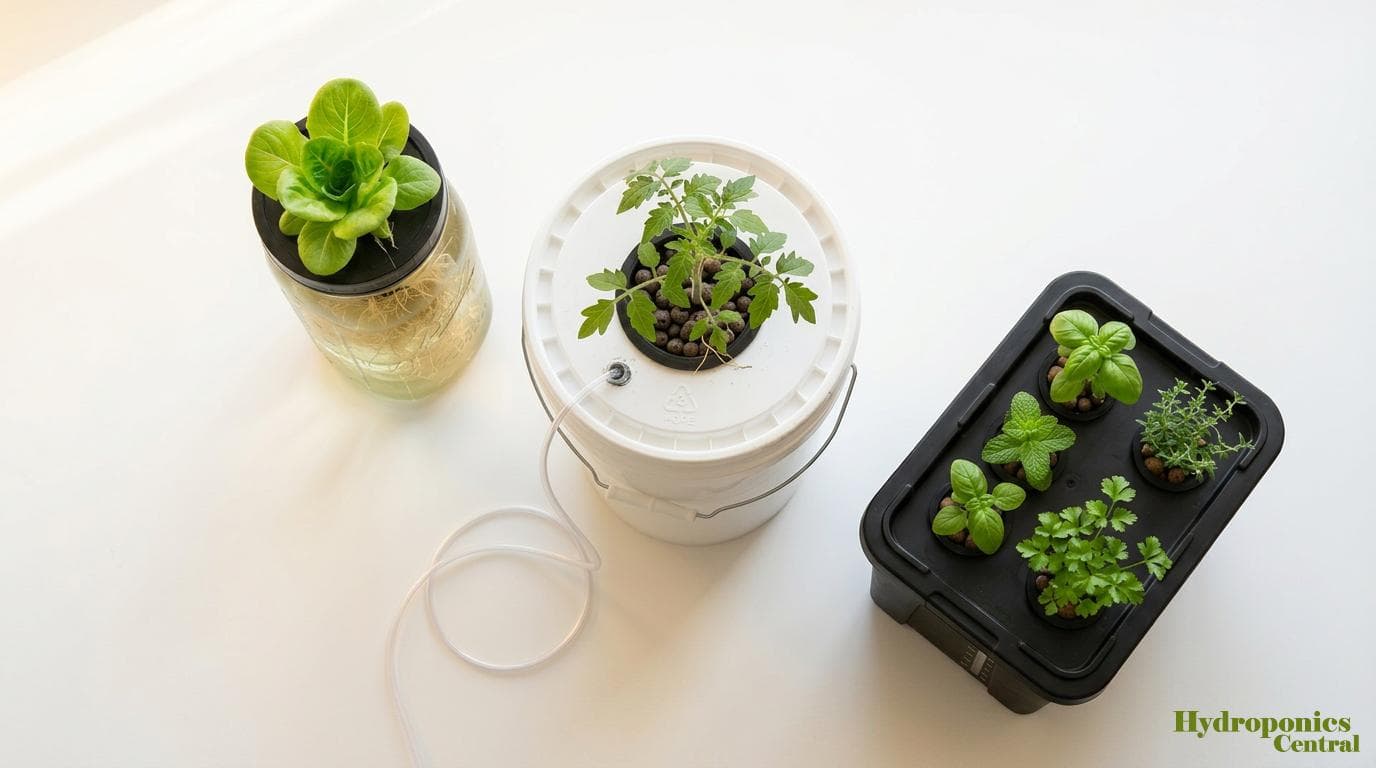
The Kratky method is the best starting point for most herb growers — it costs under $10 per herb, requires no electricity or pump, and produces the same results as more expensive systems for herbs specifically. Here are the three best options ranked for this crop type.
A note on starting seeds: Sprout herb seeds in a damp rockwool cube or paper towel first, then transplant into your net pot once roots are visible (usually 5–7 days). Direct-seeding into clay pebbles works for basil and cilantro but slows germination for thyme, oregano, and rosemary. For nutrients, the General Hydroponics Flora series works well at half to three-quarters strength — herbs are light feeders.
Kratky method — best for beginners (under $10 per herb)
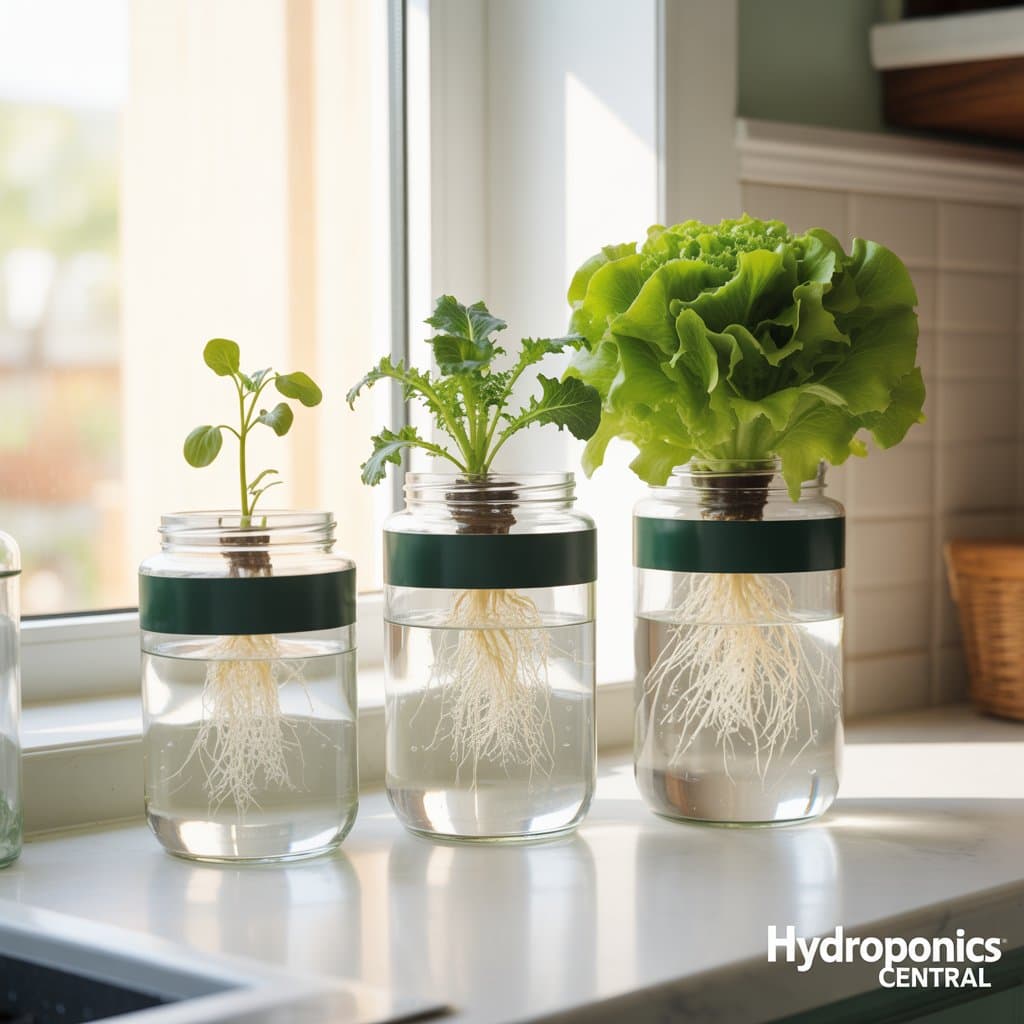
The Kratky method uses a mason jar, net pot, clay pebbles, and nutrient solution — no pump, no electricity, no moving parts. The Kratky method is ideal for beginners and small-scale herb growers because it eliminates equipment failure and electricity dependency entirely, according to UF/IFAS Extension. Set up 4–6 jars on a sunny windowsill and you have a complete herb garden for under $50.
Countertop smart gardens — best for convenience ($100–$300)
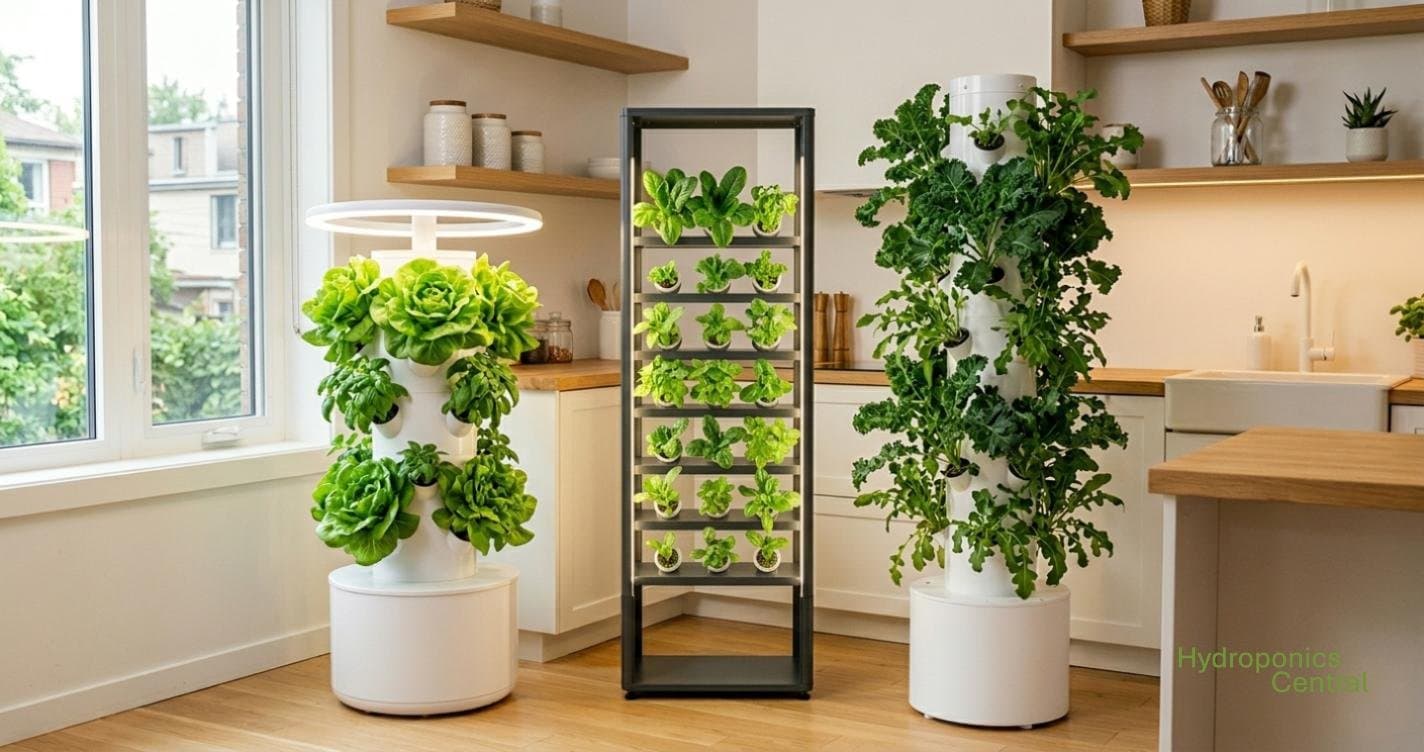
Smart garden systems (AeroGarden, Click & Grow) add automated LED lighting on a timer and built-in water reservoirs. The trade-off: proprietary seed pods cost $3–$5 each versus $0.10 for seeds in a Kratky jar. Best for growers who want zero setup complexity and don't mind the ongoing cost.
DWC totes — best for scale ($50–$100)
A single storage tote with an air pump and air stone holds a dozen net pots and is the best value for growing 8+ herbs at once. Setup cost is $50–$100 and monthly running cost is under $10. For build instructions, our DIY hydroponic garden guide covers DWC systems for under $100.
How to harvest herbs for months of continuous production
Cut-and-come-again harvesting is the technique that turns a single herb plant into 3–6 months of continuous production — cut just above a leaf node, and the plant branches rather than declining. This is the skill that separates growers who get one flush from growers who harvest all year.
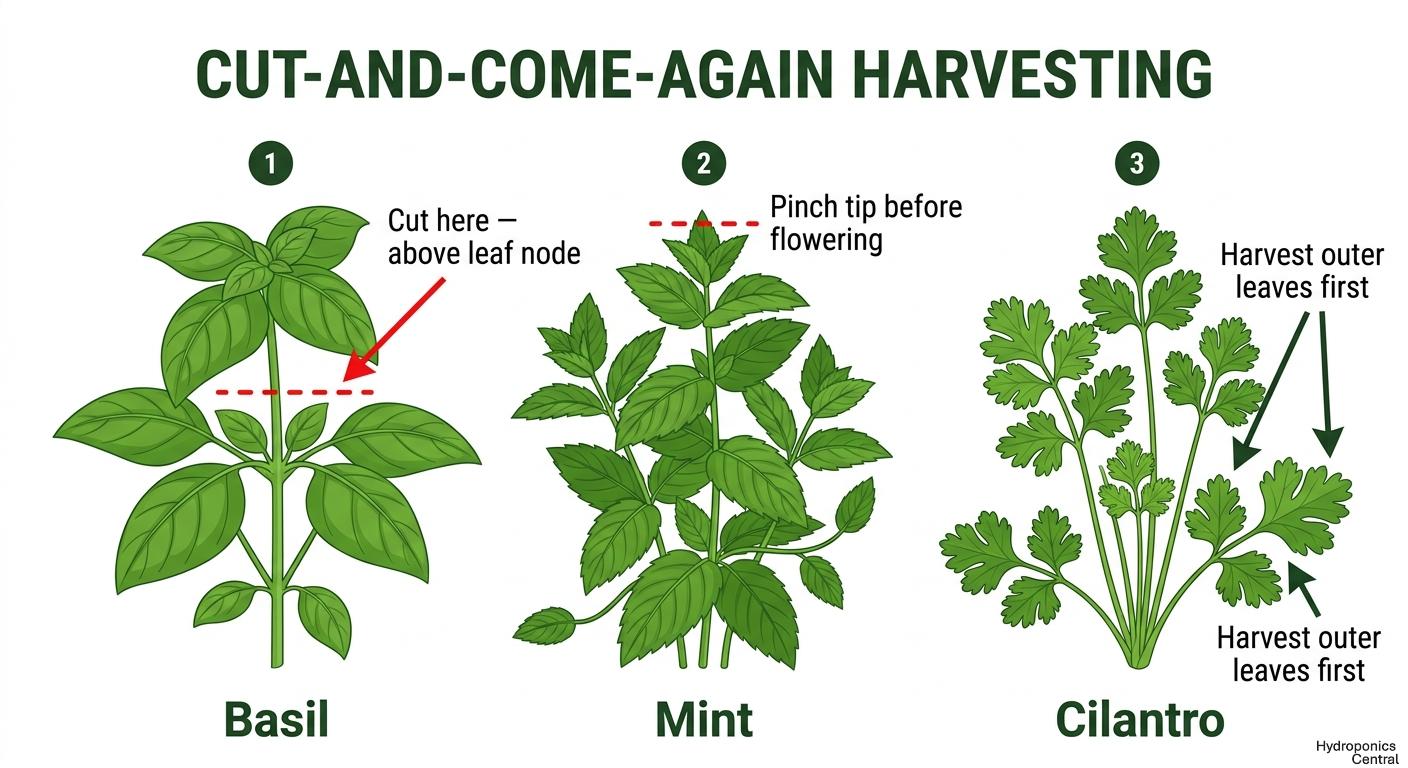
How to harvest basil
Cut stems just above a leaf node — the point where two leaves emerge from the stem. Each cut triggers two new branches from that node. Never remove more than one-third of the plant at a time. A single well-pruned basil plant can produce continuously for 3–6 months before it eventually declines.
How to harvest mint
Pinch or cut the growing tips regularly to encourage bushy, lateral growth. The critical rule: harvest before flower buds appear. Once mint flowers, the leaves turn bitter. If buds do appear, snip them off immediately and the plant will redirect energy back to leaf production.
How to harvest cilantro
Harvest outer leaves first, working inward, and leave the center growing point intact. Cilantro bolts fast in warm conditions above 70°F — once the plant sends up a tall flower stalk, leaf production stops. Stagger plantings every 2–3 weeks so you always have young cilantro coming up as older plants finish their cycle. Once a plant does bolt, let the flowers go to seed — the dried seeds are coriander, a spice worth keeping.
How to harvest parsley
Cut outer stems at the base, leaving the inner crown to keep producing. Flat-leaf (Italian) parsley regrows faster than curly varieties and has a stronger culinary flavor.
How to harvest chives, thyme, oregano, and rosemary
Cut no more than one-third of the plant at a time. These slower-growing herbs need recovery time between harvests — typically 2–3 weeks before you cut again.
The real grocery savings math
A five-herb Kratky setup producing basil, mint, cilantro, parsley, and chives can offset $150–$235 worth of fresh grocery herbs annually, for roughly $5 in seeds and nutrients. Here's the per-herb breakdown:
Annual grocery savings comparing the cost of growing hydroponic herbs versus buying fresh herbs at the store for basil, mint, cilantro, parsley, and chives.
Based on average US grocery herb prices, these estimates assume weekly harvests of about 1 oz per cut, compared to a standard grocery package of 0.5–0.75 oz, over each plant's productive lifespan.
The honest caveat: these savings assume you already have a system running. Factor in the system cost — $30–$50 for a set of Kratky jars, $100–$300 for a smart garden — to find your real break-even point. Most Kratky herb growers break even within the first 2–3 months. Smart garden owners typically take 6–12 months.
6 common mistakes with hydroponic herbs (and how to fix them)
Overfeeding, pH drift, and insufficient light cause the majority of hydroponic herb failures — and all three are easy to diagnose and fix once you know what to look for. Here are the six mistakes that derail most herb gardens, with a specific fix for each.
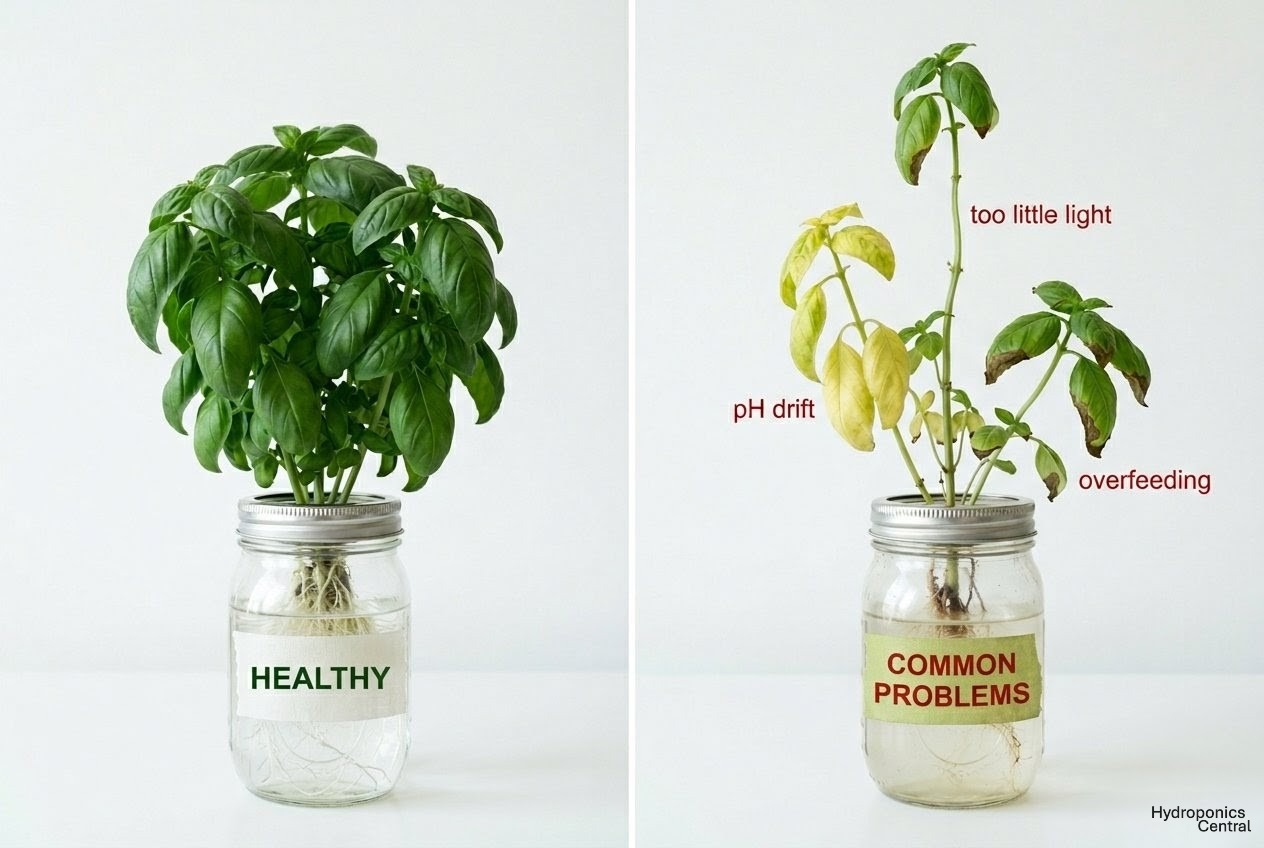
1. Overfeeding nutrients causes leaf tip burn and bitter flavor in hydroponic herbs — they are light feeders that need far lower EC than fruiting crops. An EC above 1.8 causes damage. The fix: dilute your nutrient solution to an EC of 1.0–1.6 for most herbs. Less is more with herbs — they don't need the heavy feeding that fruiting crops require.
2. Ignoring pH drift is the most common cause of yellowing leaves in hydroponic herb gardens — pH above 6.5 locks out iron and micronutrients even when they're present in the water. The pH of your nutrient water naturally shifts as plants consume nutrients. The fix: check pH twice a week and adjust back to 5.5–6.5 with pH down solution.
3. Too little light causes herbs to grow tall and leggy with pale, thin leaves — the plant is stretching toward any available light source rather than putting energy into leaves. The fix: provide 14–16 hours under LED grow lights positioned 6–12 inches above the plant canopy. A $15 clip-on LED panel is enough for a few Kratky jars.
4. Overcrowding herbs in shared containers fails because mint roots expand aggressively and choke out neighboring plants within weeks. The fix: always give mint its own container. Space other herbs at least 4–6 inches apart in any shared system.
5. Not harvesting aggressively enough causes herbs to become woody, flower, and stop producing tender leaves — regular cutting is what triggers continuous fresh growth. The fix: harvest at least one-third of each plant's growth weekly. The more you cut, the more it produces — up to a point.
6. Letting nutrient water get too warm — above 75°F — encourages root rot and speeds up cilantro bolting. The fix: keep nutrient water between 65–72°F. If your jars sit in afternoon sun, wrap them in foil or move them to a cooler spot during the warmest part of the day.
My take as a curator
A hydroponic herb garden is the single most cost-effective way to start growing your own food indoors. Of every crop I've researched for this site, herbs are the one where the math reliably works in a home grower's favour from the very first harvest — not after six months of refinement.
If you're starting from zero, go Kratky: four mason jars, basil and mint to start, a $5 pH kit, and nutrient solution. Total spend under $50, fresh herbs in three weeks. Run that for a month and you'll know whether you want to scale up to a DWC tote or stay simple. You don't need a smart garden to start — the convenience isn't worth the price premium until you've already proven the habit.
Who this isn't for: anyone who doesn't want to check pH twice a week. That's the one task that can't be skipped. Outside of that, herbs are the most forgiving hydroponic crop you can grow — they tolerate imperfect light, irregular feeding, and temperature swings that would kill tomatoes or peppers outright.
Start with basil and mint. Get your first harvest. Then decide how far you want to take it.
Join 1,000+ growers getting one curated hydroponic tip every week — subscribe to the Hydroponics Central newsletter. Free, no spam.
Key Takeaways
Quick reference summary
- 1Herbs are the ideal hydroponic crop — they grow in 21–45 days, need less light than fruiting plants, and save the most money per square foot of growing space.
- 2Basil and mint are the easiest hydroponic herbs — both tolerate a wide pH range (5.5–7.0), grow quickly, and produce continuously for 3–6 months with proper harvesting.
- 3A single hydroponic basil plant costs ~$0.30 to grow and replaces $45–$75 worth of store-bought basil over its lifetime.
- 4Cut-and-come-again harvesting is the key skill: cut basil above a leaf node, pinch mint before flowering, and harvest cilantro from the outside in.
- 5The Kratky method is the cheapest herb system — under $10 per herb jar, no electricity, no pump. Smart gardens ($100–$300) add convenience at a premium.
- 6The 6 most common mistakes are overfeeding, ignoring pH drift, too little light, overcrowding mint, not harvesting enough, and letting nutrient water get too warm.
Frequently Asked Questions
Common questions from our readers
Written by
Carl — Hydroponics CuratorI research hydroponics so you don't have to — going through university studies, extension programs, and grower communities to find what actually works for home growers.
I'm a content curator and researcher, not a licensed agronomist or commercial grower. Everything published here is sourced from credible third-party research, which is always linked inline. When in doubt, consult your local agricultural extension office. Learn more about how I research →
Found this helpful? Share it!